Report from the presentation in Leonberg
Why “Using more dogs less” is one of the most important issues
in modern dog breeding
Is your dog a family dog or a show dog?
What is really most important to us dog lovers?
Beauty, homogeneity or a long and healthy life?
For most people, the answers are obvious: a dog is a member of the family, and we want it to live a long and healthy life. This was also the common starting point when Niels Steinmetz, president of the Dutch Leonberger Club and the International Leonberger Union, gave his presentation “Using more dogs less” in Leonberg at the end of September 2025.
Genetic diversity– the basis for healthy dogs
We see the same pattern in all pure breeds. The studbooks are closed and a small number of individuals are used over and over again for breeding. The result? A rapidly declining genetic diversity.
Why is genetic diversity important? Our dogs need it for a functioning immune system, health, normal litter size, normal size and perhaps most importantly, a long lifespan. As the diversity decreases, dogs become more vulnerable to disease, especially autoimmune diseases, which we are already seeing an increase in many breeds.
Overuse of males – a hidden but serious problem
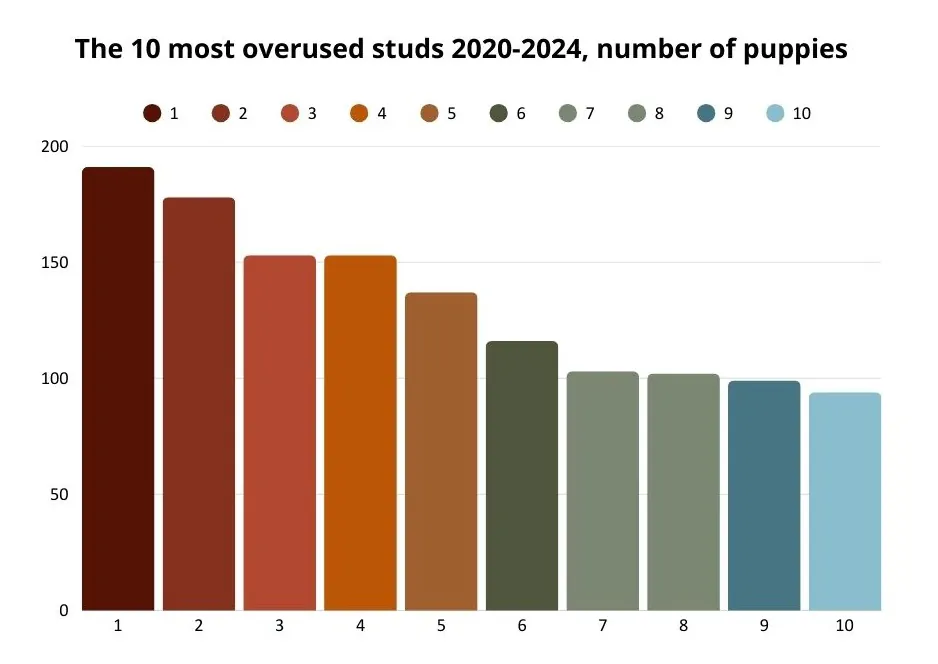
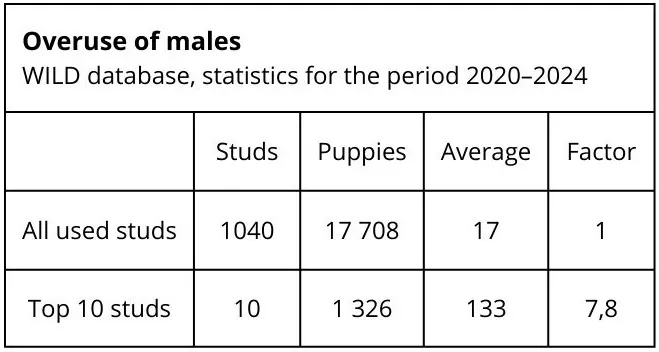
A clear example is the overuse of male dogs. Although the population consists of roughly equal numbers of females and males, only about 2-3 percent of males are actually used for breeding. Some males sire hundreds of puppies, while the majority are never used. In the WILD database, statistics for the period 2020–2024 show that the average number of puppies per male used for breeding was 17. However, the ten most used males had an average of 133 puppies. This means that they have about eight times as many puppies as the average for all males used for breeding. If we look further back in time, we find a male with over 270 puppies. If we use the “reverse pedigree” function in the database today, we see that this male now has more than 40,000 descendants. This is where the problem lies. It is not a problem linked to individual dogs, but to the method. When we overuse a small number of individuals, we risk the future health of the breed. We need to have more dogs in breeding, especially males. And we need to make that change now.
DLA – a tool for the future
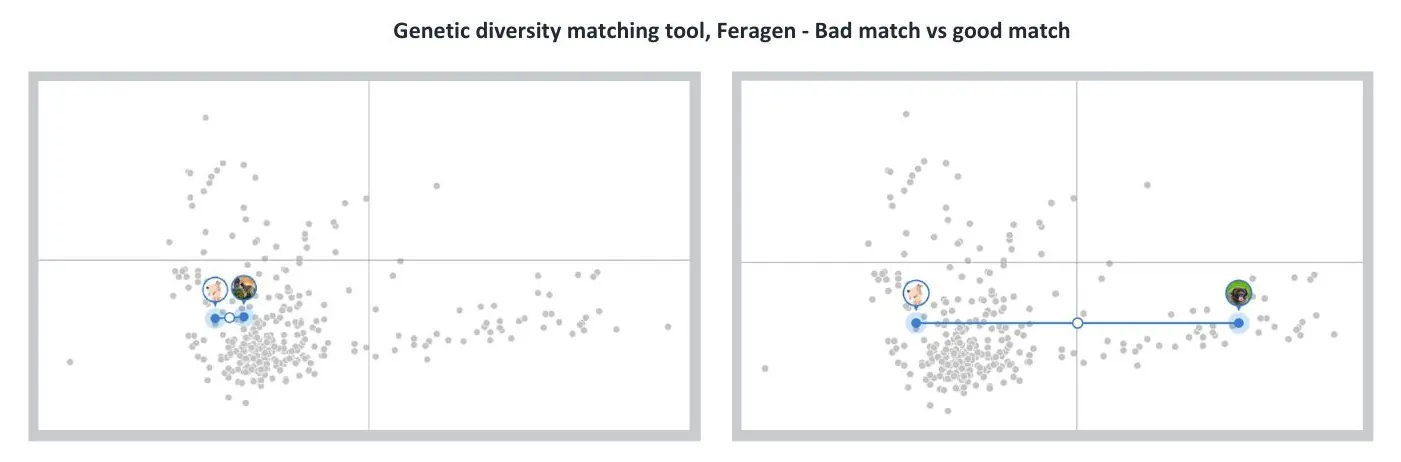
What can we do now? One of the tools that can help us is DLA (Dog Leukocyte Antigen) testing. DLA genes are central to the immune system, and the greater the variation a dog has here, the better equipped it is to fight disease. The Leonberger currently has 15 known haplotypes in the Feragen database, which is relatively high compared to some breeds that only have two left. However, we see that a few of these haplotypes are predominantly found in our dogs, while other gene variants are almost non-existent in number. The DLA test and the genetic diversity matching tool available through Feragen provide us with valuable knowledge about which combinations strengthen the breed genetically. In order to get access to the matching tool the tests for Genetic Diversity and DLA Haplotype Typing are needed.
We can act now to slow down the loss of genetic diversity through conscious choices. This helps us plan matings in a completely different way than just looking at pedigrees.
Why Feragen?
Feragen is one of the laboratories that offers DLA testing. They currently have the largest database, with around almost 400 tested dogs. This does not represent all Leonbergers, but it is the largest database of Leonbergers tested for DLA so far. More importantly, Feragen is currently the only provider that offers a dog matching tool focused on genetic diversity.
Feragen offer a attractive package deal: Dogcheck 4.0
The package includes LPN1, LPN2, LPPN3, LEMP + Genetic Diversity + DLA Haplotype Typing + ISAG 2020 and 141 other diseases.
The risk of a Leonberger testing positive for one or more of these other diseases is negligible. However, the breeder can use it to demonstrate that they have done everything possible to prevent hereditary diseases in their offspring. In addition, Dogcheck 4.0 is financially attractive for a dog that hasn’t yet been tested for LPN and LEMP.
Heterozygote, homozygote – and the misunderstandings in between
A common misconception is that homozygote dogs are “worse.” This is not the case. All dogs, regardless of their genetic makeup, can be valuable in breeding, but it depends on how they are combined. A homozygote dog, which has inherited the same set of DLA haplotypes from its parents, can still produce a litter of heterozygote dogs. The goal is not perfection, but balance. Consciously planning matings that contribute to greater genetic diversity over time. The first and most important step is to start DLA testing our dogs so that we can build up the database at Feragen’s laboratory with more individuals. Who knows, maybe we will then also find more haplotypes.
Mean Kinship – an overview of the population
Another tool we have for the breed is Mean Kinship. This is a measure of relatedness across the entire population. It provides an overview of the entire breed population based on a calculation of the pedigrees in the WILD database. It is calculated for all dogs between 2-10 years old (males) and 2-8 years old (females). We cannot use Mean Kinship as a breeding tool, but only as a tool that tells us something about the population at a general level. It does not tell us anything about the DNA of individual dogs. The DLA test and the genetic diversity matching tool, on the other hand, are breeding tools that support our work.
Act now – before the options disappear
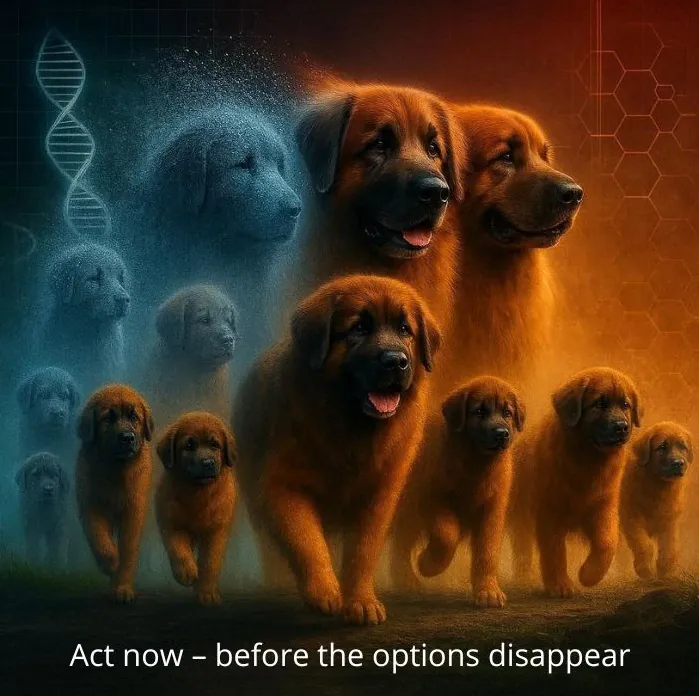
An important message from the presentation is that we can’t wait. Once genetic diversity is lost, then it is too late. That is why the Dutch club has introduced concrete measures: limiting the number of puppies per male, mandatory DLA tests for all dogs used for breeding, and simplified rules to allow more males to be used for breeding.
The message was clear!
Talk about this with your breeders.
Talk about what you can do to use more dogs for breeding and make sure to use them less.
You don’t have to follow the actions taken in the Netherlands, but talk about what you can do in your club to increase genetic diversity.
If we want genetic diversity and maintain what we have, we need to use more dogs in breeding. And perhaps now is the time to ask ourselves the same question that the audience was asked that evening:
Do we want beautiful homogeneous dogs, or dogs that live long and healthy lives?
The choice is simple, and the change we need now is a shared responsibility. Are you ready to be a part of this change?
To view the recording of the presentation in Leonberg, follow the link to YouTube here:
https://youtu.be/5zw7A4iPlR4?si=99o7F7b_nF4PdgT-
To order a DLA test and read more about how it works, follow the link here:
https://leonbergerunion.com/feragen/
(information is available in German, English, Dutch and French)